Tickets Amsterdam

Plan your visit to Body Worlds Amsterdam

Body Worlds Amsterdam is a permanent anatomy exhibition best known for its plastinated human bodies and its unusual ‘Happiness Project’ theme. The visit is compact rather than sprawling, but it’s dense enough that rushing through means you’ll miss the context that makes the specimens meaningful. What separates a good visit from a flat one is following the top-down route and leaving a few extra minutes for the InBody scan at the end. This guide covers timing, tickets, arrival, and what to focus on once you’re inside.

Quick overview: Body Worlds Amsterdam at a glance

This is an easy museum to fit into a city day, but a little planning makes it much better.

  • When to visit: Monday–Sunday, 10am–10pm. Weekdays after 6pm are noticeably calmer than weekends from 11am to 3pm, because Damrak foot traffic drops and you can actually pause around the full-body plastinates without people stacking up behind you.
  • Getting in: Tickets start from €22.50 for the The Happiness Project skip-the-line entry. You can also choose combo options, including a canal cruise (€35), National Maritime Museum (€39.51), Rijksmuseum (€45.13), or NEMO Science Museum (€41.80). An I Amsterdam City Card is available from €67 for broader access across attractions. Walk-ins are usually possible in the low season, but it’s best to book ahead for summer weekends and rainy afternoons when demand is higher.
  • How long to allow: 1–1.5 hours for most visitors. It stretches closer to 2 hours if you read every panel, use the audio guide, and do the InBody scan at the end.
  • What most people miss: The diseased-versus-healthy organ comparisons and the prenatal development floor, both of which are easy to rush past once visitors feel they’ve already seen the headline body displays.
  • Is a guide worth it? Usually no—a good audio guide does the job for less, because the route is linear and the labels are already clear in English and Dutch.

🎟️ Tickets for Body Worlds Amsterdam sell out a few days in advance during summer weekends and school holidays. Lock in your visit before the time you want is gone.

See ticket options

Jump to what you need

Where and when to go

💡 Pro tip

Late-evening slots work especially well here because Body Worlds stays open long after most museums, and the compact galleries feel much easier to navigate once the midday Damrak crowd has thinned.

How much time do you need?

Visit typeRouteDurationWalking distanceWhat you get

Highlights only

Top floor intro → whole-body plastinates → circulation and lung displays → InBody scan → exit

1 hr

~0.8 km

You’ll see the most striking specimens and the included scan, but you’ll move quickly past the deeper text panels and the prenatal section.

Balanced visit

Top floor intro → coordination and locomotion floors → circulation and respiration/digestion → prenatal development → InBody scan → exit

1.5 hr

~1 km

This adds the strongest organ comparisons and the floor many visitors rush through, giving you the full story without turning it into a long museum session.

Full exploration

Full top-down route with all six gallery floors → multimedia panels → audio guide stops → InBody scan → gift shop

2 hr

~1.2 km

This is the version that makes the happiness-and-health theme land properly, but it rewards focus more than stamina and can feel intense if you try to read everything.

Which ticket does your route need?

✨ The full exploration route is easier with The Happiness Project skip-the-line ticket, with add-ons like a canal cruise. Spanning multiple floors, the exhibition explores how emotions affect the human body—this ticket helps you take your time, avoid queues, and fully connect with the exhibits before the crowds arrive. → See your ticket options

Which Body Worlds Amsterdam ticket is best for you?

Ticket typeWhat's includedBest forPrice range

Body Worlds Amsterdam: The Happiness Project Ticket

Skip-the-line access and entry to Body Worlds Amsterdam, InBody Scan

A flexible, self-paced visit where you explore the exhibition at your own pace

From €22.50

With Canal Cruise

Entry to Body Worlds admission, InBody Scan, 1-hour canal cruise, GPS multilingual audio guide for the cruise

Combining your museum visit with a relaxing Amsterdam canal cruise in one booking

From €35

With National Maritime Museum

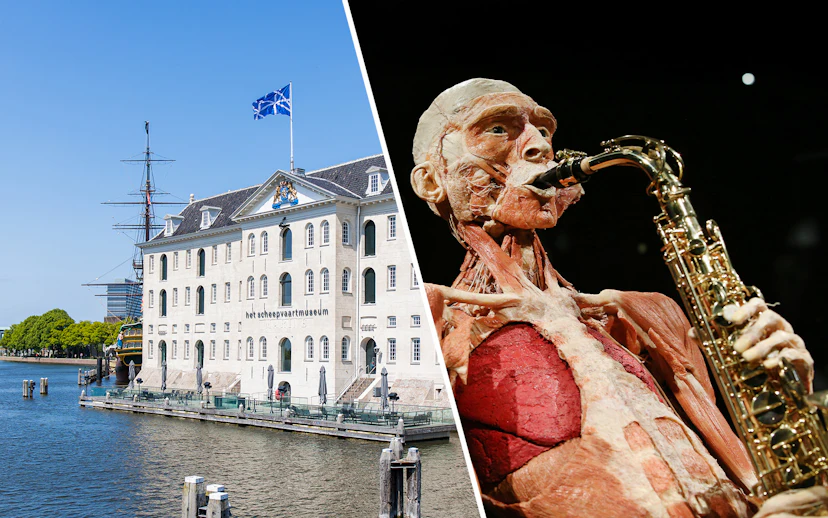
Skip-the-line entry to the National Maritime Museum, access to all exhibitions, access to the replica ship “Amsterdam”, multilingual audio guide, skip-the-line entry to Body Worlds, InBody Scan

A structured two-site experience linking human anatomy with Dutch maritime history

From €39.51

With Rijksmuseum

Entry to the Rijksmuseum, access to all permanent collections and temporary exhibitions, skip-the-line access to Body Worlds Amsterdam, entry to Body Worlds Amsterdam, InBody Scan

A cultural day combining Dutch art and human anatomy in one itinerary

From €45.13

NEMO Science Museum

Fast-track entry to both venues, Body Worlds admission, InBody Scan, NEMO hands-on exhibits, lab experiments, chain reaction demo

A highly interactive science-focused day across two nearby attractions

From €41.80

I Amsterdam City Card

24–120 hour validity pass with access to 70+ attractions, unlimited public transport, canal cruise, bike rental, discounts, and optional audio guides.

Multi-attraction city exploration with transport included across Amsterdam

From €67
⚠️ Watch out for unofficial sellers

Street vendors and kiosks near Body Worlds Amsterdam may offer overpriced or invalid tickets. To avoid issues, book only through the official site or a verified partner — invalid tickets will still require you to join the general queue, with no recourse.

How do you get around Body Worlds Amsterdam?

What happens inside Body Worlds Amsterdam?

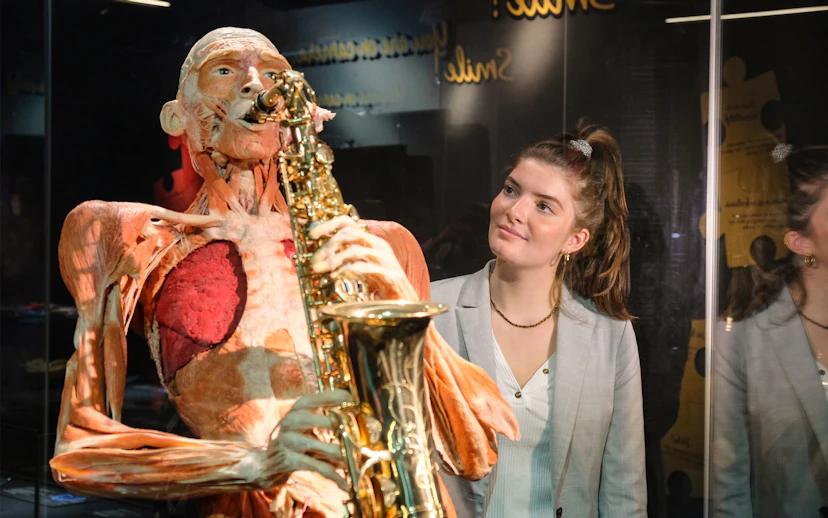
Whole-body plastinates at Body Worlds Amsterdam
Circulation and lung comparison displays
Brain and nervous system exhibits
Prenatal development gallery at Body Worlds
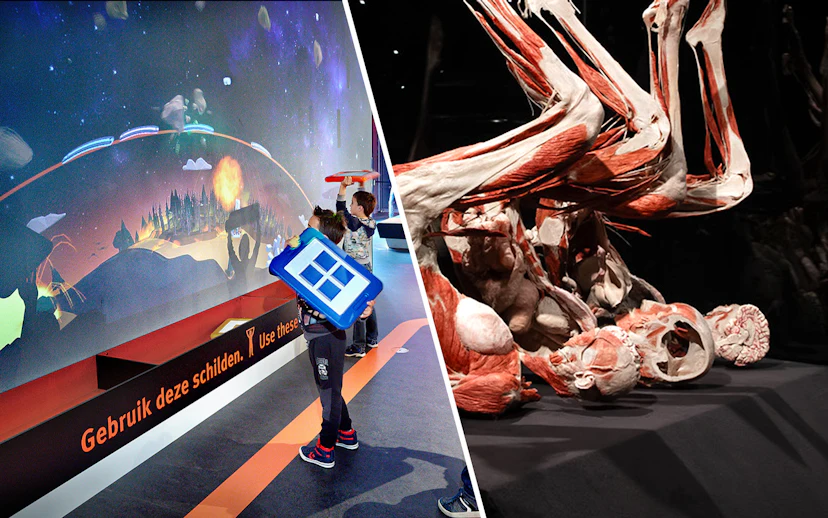
Happiness Project interactive exhibits
InBody scan station at Body Worlds Amsterdam
1/6

Whole-body plastinates

Display type: Full-body anatomical specimens

These are the displays most people come for: real human bodies preserved through plastination and posed to show how muscles, tendons, and nerves work in motion. They’re visually striking, but the point isn’t shock—it’s function. What many visitors rush past is the detail in the smaller structures, especially the fine vessel networks and how differently the same muscle groups look in athletic versus neutral poses.

Where to find it: Early in the main route after heading up to the top floors.

Circulation and lung comparisons

System focus: Heart, blood vessels, and respiratory health

This section is where the exhibit becomes less abstract and more personal, especially when it places healthy organs next to damaged ones. The side-by-side lung displays are the part many visitors remember most because the lesson is immediate, not theoretical. What gets missed is the vessel detail around the heart, which is easier to appreciate if you stand back first, then move in close.

Where to find it: Midway through the route on the circulation and respiration-focused floors.

Brain and nervous system displays

System focus: Coordination and neural control

This floor explains how the body is directed rather than just how it is built, which gives the later movement and organ displays much more meaning. It’s less visually dramatic than the large full-body figures, so people often move through it too fast. Slow down for the nerve pathways and the panels linking mood, stress, and physical health—they’re key to the Amsterdam ‘Happiness Project’ angle.

Where to find it: Near the start of the visit on the upper floors.

Prenatal development gallery

System focus: Human development

This is one of the most thoughtful parts of the museum, showing stages of embryonic and fetal development with unusual clarity. It tends to be quieter than the headline displays, partly because it’s more reflective and partly because some visitors move past it quickly with children. The detail most people miss is how carefully the developmental timeline has been explained, making it more educational than sensational.

Where to find it: Toward the later part of the route, before you return to the ground-floor exit area.

Happiness Project interactives

Theme focus: The link between emotion and physical health

What makes the Amsterdam edition different is that it doesn’t treat anatomy as a closed system; it keeps connecting the body to stress, mood, and daily choices. The interactive panels are where that message becomes clear. Many visitors read the opening claim about happiness and move on, but the later stations are where the theme gets backed up with the strongest health examples.

Where to find it: Woven through the route, starting from the introduction and recurring on multiple floors.

InBody scan

Interactive feature: Personal body composition analysis

This is more than a novelty add-on. The scan measures things like body fat, muscle mass, and water balance, which makes the visit feel personal after you’ve spent an hour looking at anatomy in general terms. The easy-to-miss detail is that it’s included in your ticket, so don’t walk straight past it on the way out assuming it’s a separate paid extra.

Where to find it: On the ground floor near the end of the visit.

💡 Don't leave without seeing

The prenatal development floor and the healthy-versus-diseased organ comparisons are the easiest parts to miss, because crowd flow pulls most people toward the dramatic full-body figures first and the exit later.

Facilities and accessibility

  • 🎒 Cloakroom / lockers: Lockers are available near the lobby for bags, and they’re useful because large backpacks are awkward in the compact galleries.
  • 🛍️ Gift shop / merchandise: There’s a small shop near the exit with anatomy-themed books, puzzles, and Body Worlds souvenirs that make more sense for curious adults and older kids than for quick impulse buys.
  • 🪑 Seating / rest areas: Benches and resting spots are placed throughout the building, which helps if you want to break up the visit floor by floor.
  • 📶 Wi-Fi: Most visitors rely on mobile data instead of treating this as a linger-and-browse venue, so download anything you need before entry.
  • Mobility: The building is wheelchair accessible, with an elevator connecting the gallery floors and step-free movement once you’re on each level.
  • 👁️ Visual impairments: The audio guide is available in 6 languages and is the best add-on here if you prefer listening to explanations rather than reading every label.
  • 🧠 Cognitive and sensory needs: Weekday evenings are the calmest time to visit, while weekend midday slots feel louder and tighter because the galleries are compact and visitor flow is vertical.
  • 👨‍👩‍👧 Families and strollers: Strollers are allowed, but they’re easier to manage in quieter slots because the circulation points between floors can feel tight when the museum is busy.

Body Worlds Amsterdam works best for curious school-age children and teenagers who like science, medicine, or unusual museums, but younger kids usually do better if you explain the ‘real human bodies’ concept before you arrive.

  • 🕐 Time: Around 60–75 minutes is realistic with children, and the full-body plastinates plus one or two organ floors usually hold attention best.
  • 🏠 Facilities: Lockers and elevator access help families manage coats, bags, and strollers without turning the visit into a logistical hassle.
  • 💡 Engagement: Turn it into a spot-the-system game—ask children to find the heart, lungs, muscles, and nerves as they move floor by floor.
  • 🎒 Logistics: Bring a light bag, skip the heaviest stroller you own, and aim for a weekday late-afternoon or evening slot if you want a calmer visit.
  • 📍 After your visit: Madame Tussauds Amsterdam is a short walk away on Dam Square and works well if your kids want something lighter after the anatomy-heavy experience.

Rules and restrictions

⚠️ Re-entry restrictions

Re-entry is not permitted once you exit Body Worlds Amsterdam. Plan restroom stops, meals, and rest breaks before leaving—the nearest cafés are outside on Damrak, and going back means starting the entry process again.

Practical tips

  • Book the exact time you want on summer weekends, but in winter or on weekday evenings you can usually be more relaxed because Body Worlds is not an attraction that regularly needs months of advance planning.
  • If you’re running late, don’t panic too early—timed entry matters most during busy periods, and arriving 10–15 minutes before your slot is enough on most days.
  • Take the elevator up first and work down because the exhibit has been designed as a top-down story and it feels flatter if you wander in and out of sequence.
  • Save your attention for the middle and later floors, where the healthy-versus-diseased organ comparisons and prenatal section add the substance many visitors miss.
  • A small bag makes a real difference here; compact galleries feel much easier when you’re not managing a coat, shopping bags, or a large backpack.
  • Don’t plan lunch for the middle of the visit because there’s no real reason to break a 1–1.5-hour route, and re-entry is not part of the experience.
  • Weekday evenings are the sweet spot if you want a quieter visit, because Body Worlds stays open later than most museums and Damrak foot traffic drops after the daytime rush.

What else is worth visiting nearby?

Eat, shop and stay near Body Worlds Amsterdam

  • On-site: There isn’t a full sit-down café inside, so most visitors eat before or after their slot on Damrak or around Dam Square.
  • Pancakes Amsterdam (3-minute walk, Damrak 44): Dutch pancakes, sweet and savory options, and a reliable pre-visit choice if you want something quick but sit-down.
  • Café de Roode Leeuw (5-minute walk, Damrak 93–94): Dutch classics in a more traditional setting, and a better fit after the visit if you want an actual meal rather than a snack.
  • Burger Bar Kolksteeg (6-minute walk, Kolksteeg 2): Fast, filling, and easy if you want a casual stop without turning lunch into a long break.
  • Pro tip: Eat before you go if you’ve booked a midday slot, because Damrak gets busier around lunch and there’s no real upside to breaking a 90-minute visit into two parts.
  • Body Worlds gift shop: Anatomy books, puzzles, and themed souvenirs near the exit, which are best if you want something tied directly to the visit.
  • De Bijenkorf: A large department store a minute away near the tram stop, useful if you want mainstream shopping without detouring across the city.

Staying near Damrak is convenient, but it’s not the most characterful base in Amsterdam. It works best if you’re arriving by train, have a short trip, or want to walk to major central sights without thinking too hard about transit. For longer stays, many visitors prefer a neighborhood with less noise and better evening atmosphere.

  • Price point: Mostly mid-range to high for central hotels, with convenience driving the price more than charm.
  • Best for: Short city breaks, one-night stays, and travelers who want Amsterdam Centraal, Dam Square, and several indoor attractions within easy walking distance.
  • Consider instead: The Jordaan or Museum Quarter if you want a calmer base with better neighborhood feel, or De Pijp if you want more food options and a less tourist-heavy evening scene.

Frequently asked questions about visiting Body Worlds Amsterdam

Most visits take 1–1.5 hours, though a slower visit with the audio guide and InBody scan can stretch to about 2 hours. It’s a compact museum, but the route is dense enough that reading every panel adds time. If you’re fitting it into a busy day, 90 minutes is the safest amount to budget.